Short answer
Palms are the most commonly mis-pruned trees in Florida, and the mistake is almost always the same: taking off too much. It comes from a reasonable-sounding instinct — fewer fronds means less wind resistance — that turns out to be backwards.
Here is how palm biology actually works and what proper trimming looks like on the species we deal with around St. Augustine.
Why palms are not like other trees
A palm has one growing point, called the bud or heart, at the very top of the trunk. Damage it and the palm dies — there is no branching, no regrowth, no second chance. That single fact drives everything about how palms should be handled.
Palms also have no cambium layer, which means they cannot compartmentalize wounds or heal over cuts the way a hardwood does. Every scar on a palm trunk is permanent, and every cut into the trunk is a permanent entry point for pathogens.
Finally, palms mobilize nutrients out of older fronds before those fronds die. A yellowing lower frond is not waste — it is actively feeding potassium and magnesium back into the plant. Cut it off green and you have thrown away nutrition the palm was in the middle of reclaiming.
The 9-and-3 rule
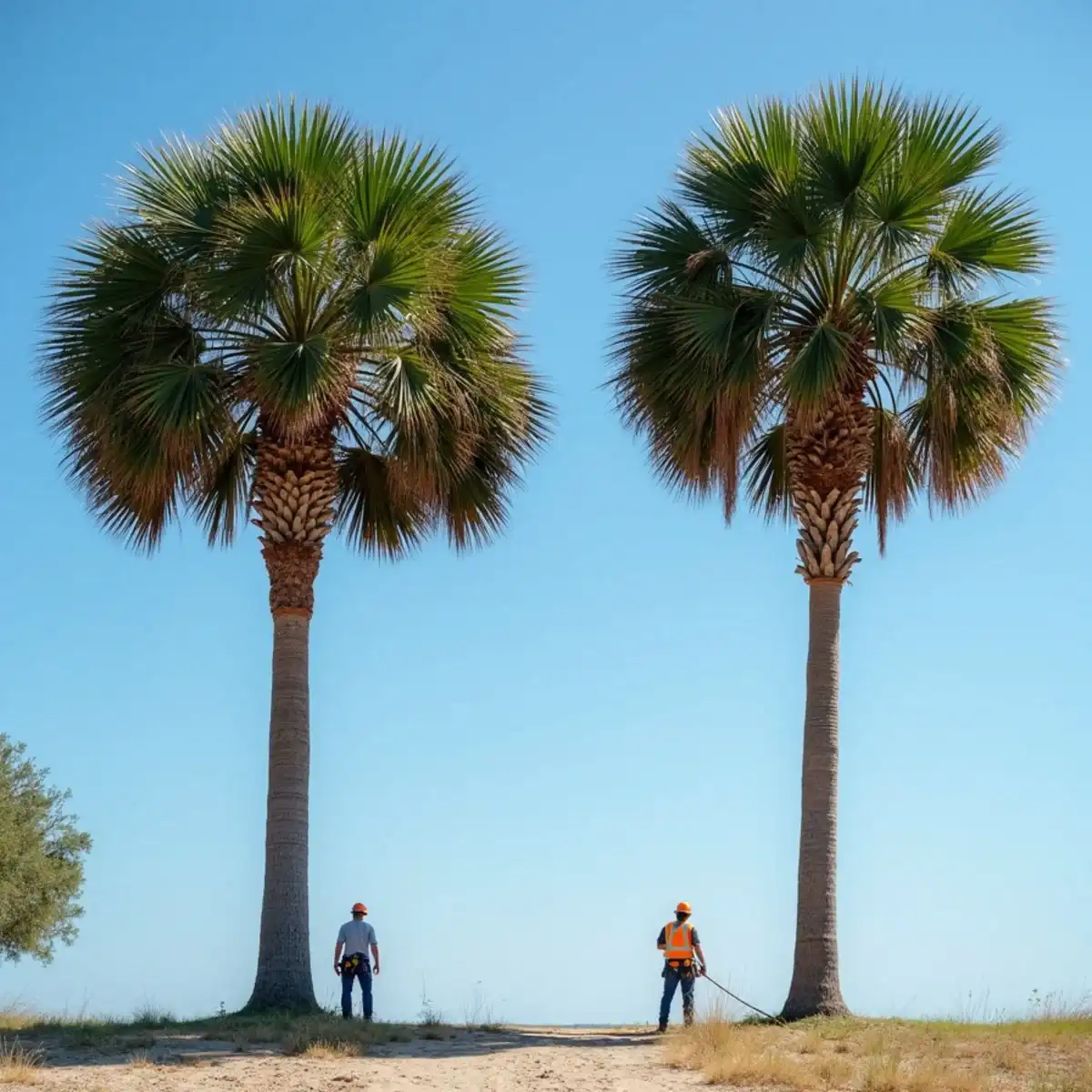
The standard is simple enough to remember at a glance. Picture the palm canopy as a clock face. Everything between 9 o’clock and 3 o’clock — the fronds at or above horizontal — stays. Everything below horizontal is fair to remove, along with fully dead brown fronds, seed pods and flower stalks, and loose old frond bases.
Cutting up into the 9-to-3 zone is where the damage happens. Over-pruned palms grow narrower trunks at the height where they were stripped, and that narrowed section stays as a permanent weak point in the trunk for the rest of the palm’s life. They also become more susceptible to cold damage and nutrient deficiency.
Why the "hurricane cut" makes palms less safe
The over-stripped look you see all over the beaches is usually sold as storm preparation. It does the opposite.
Palms evolved for high wind. The trunk flexes, the fronds shred rather than catching like a sail, and the remaining canopy shields the bud. Strip that canopy down to a handful of upright fronds and you have removed the protection the growing point relies on, weakened the trunk, and starved the palm going into the season when it most needs reserves.
Proper storm preparation for a palm takes about ten minutes: dead fronds off, seed pods and flower stalks off, loose boots cleared. Those are the projectiles. The green canopy stays.
Species notes for Northeast Florida
The palms around St. Augustine each behave a little differently.
Sanitation matters more than people think
Fusarium wilt is a fatal palm disease spread primarily on contaminated pruning tools. A saw used on an infected Canary Island date palm will carry the pathogen to the next palm it touches, and there is no cure.
Anyone servicing your palms should be sanitizing between trees. If a crew moves down a row of palms with the same chainsaw and no sterilization step, that is a real risk, not a technicality.
When yellow fronds are a nutrition problem, not a pruning problem
A large share of the "sick palm" calls we take are nutrient deficiency, which is extremely common in the sandy soil across St. Augustine Beach, Vilano, and the coastal communities.
Potassium deficiency shows up as yellow-orange spotting and necrosis on the oldest, lowest fronds. Manganese deficiency ("frizzle top") deforms the newest growth at the top. Both are correctable with a proper slow-release palm fertilizer applied to the root zone.
The instinct is to cut off the ugly fronds. Do not — on a potassium-deficient palm those fronds are the nutrient source the palm is drawing from, and removing them accelerates the decline. Fix the nutrition and let the palm recover.
Frequently asked questions
The bottom line
Proper palm trimming is quick, inexpensive, and almost entirely about restraint. If your palm looks like a feather duster after a service, you paid someone to damage it.
We service palms across the coast to the 9-and-3 standard and check every trunk base for ganoderma while we are up there. Our palm tree trimming page covers what a visit includes.
Want a real answer about your specific tree?
Call +1 (208) 635-2100 for a free on-site estimate across St. Augustine and St. Johns County. We will tell you plainly what it needs — including when the answer is nothing.
- 47 five-star reviews
- Licensed & insured
- 24/7 storm response