Short answer
Once a tree is down, you have a decision to make about what is left. Most people use "stump grinding" and "stump removal" interchangeably, and tree companies quote them very differently — so it is worth understanding what you are actually buying.
For the vast majority of Northeast Florida properties, grinding is the right answer. Here is why, and the specific cases where it is not.
What grinding actually does
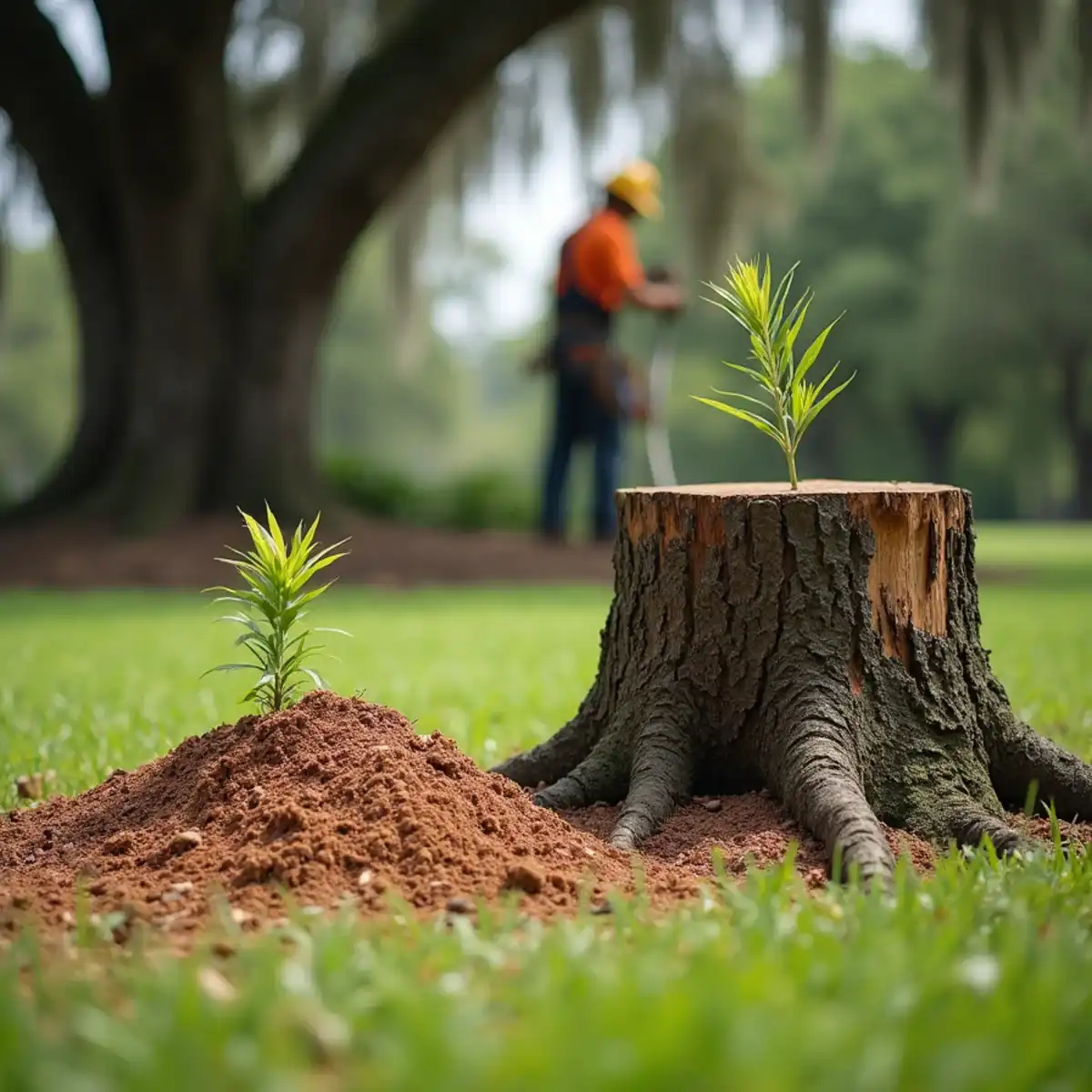
A stump grinder is a wheel studded with carbide teeth that sweeps across the stump, taking off an inch or two per pass. It chews the stump and the main root flare into chips, working down below ground level and outward as far as the flare extends.
Standard depth in our work is six to twelve inches below grade. That is enough to lay sod, plant a bed, run a fence line, or put pavers over the spot. If you plan to replant a tree in the same hole we go deeper and chase roots wider, because a mat of decaying wood is a poor place for a young root system.
What grinding does not do is remove the lateral roots running out under your yard. Those stay in the ground and decompose over several years, which is entirely fine under sod, mulch, and beds.
What full removal means
Full stump removal is excavation — bringing in a machine to dig out the entire root ball and haul it away. It is a genuinely different operation.
It costs several times more than grinding. It tears up a large area of surrounding lawn, and anything in the way — irrigation lines, landscape lighting, nearby plantings — comes out with it. And it leaves a substantial hole that has to be backfilled with clean fill and compacted properly, or you get settling later.
There are legitimate reasons to do it: a structural footing going in exactly where the stump sits, a pool excavation, a driveway or slab pour over the location, or utility work that has to pass straight through. Outside those cases, it is money spent for no additional benefit.
What to do with the grindings
Grinding produces two to three times the volume of the visible stump in chips, which surprises people. You have three options.
Why you should not just leave the stump
Doing nothing is always an option, and in Florida it is usually a bad one.
A decaying stump is a termite and carpenter ant colony a few feet from your house. It is a trip hazard in the dark and a mower killer in daylight. And with species like camphor, Chinese tallow, water oak, and Brazilian pepper, it is a regrowth machine — the root system stays alive and pushes suckers for years.
The other consideration is timing. Grinding a fresh stump while the crew and equipment are already on site costs less than bringing a grinder back as a separate trip later. If you are getting a tree removed and you know you want the stump gone, bundle it.
Surface roots and palm stumps
Two related jobs come up constantly in our area.
Surface root grinding: mature oaks in older neighborhoods lift sod, crack walkways, and catch mower decks. We can grind offending roots below grade — but there is a limit. Cut too many roots, or cut them too close to the trunk, and you destabilize a tree you meant to keep. On a large oak, that limit is closer than most people expect, and sometimes the honest answer is a raised bed or a re-routed walkway instead.
Palm stumps: palm trunks are fibrous rather than woody, so they grind fast, but sabal palms have a dense root initiation zone that can extend several feet across. Grinding has to go wide enough to clear it or you will get regrowth around the edges.
Frequently asked questions
The bottom line
For almost every residential situation, grinding gives you everything you need at a fraction of the cost and disruption of full excavation.
Our stump grinding service covers utility locates, grinding depth to suit what you are putting there, and your choice of what happens to the chips.
Want a real answer about your specific tree?
Call +1 (208) 635-2100 for a free on-site estimate across St. Augustine and St. Johns County. We will tell you plainly what it needs — including when the answer is nothing.
- 47 five-star reviews
- Licensed & insured
- 24/7 storm response